Materials
Polyolefin, PVC, EPDM, silicone: choosing on temperature and chemistry
+125 °C, +110 °C, +100 °C, 105 °C. Four published continuous limits cover this entire catalogue, and the compound sets every one of them.
The network's single materials page
Sibling sites deleted their materials sections and link here. The temperature table and the tracking mechanism are argued once against one set of datasheets, instead of four times against four.
Two questions settle the compound, in this order. What is the continuous service temperature at the surface being covered, and what is that surface made of.
Diameter comes third. Every material here is offered across overlapping sizes, so nothing is eliminated by diameter until temperature and chemistry have eliminated it first. Reverse that order and you find a grade that fits 34 mm, then find it is 15 °C short.
What the range is actually made of
The heat-shrink side is one polymer. GSC thin wall, GLC-SV vented, GDW dual wall, GMW and GHW, the GRT red build-up grade, GDLT double layer, GAT anti-tracking, the GVOT stress-control sleeve and the GSF closure tube all name crosslinked polyolefin. Wall, ratio, filler and lining separate them. Chemistry does not.
One heat-shrink part breaks that. GCT screening tube is a thermally stabilised crosslinked semi-conductive polymer, and the sheet never calls it polyolefin.
Cold shrink splits properly. GCTE is EPDM, GCTS is silicone, and the two datasheets carry identical selection charts: seven sizes 20/7 to 104/42, Lf 500 mm minimum, an 8 to 94 mm application range, copper or aluminium to 1000 sq.mm. Only the code letter and the property column differ. Both stop at 1.1 kV, and nothing in the cold-shrink range goes above it.
PVC is in the range. It does not shrink.
The company started as a PVC processor in 1979 and has moulded PVC since 1988, and vinyl parts are still published: the busbar boot and shroud to 36 kV, the wildlife shroud and the TCV terminal cap are each described as specially formulated polyvinyl chloride. All are moulded. No PVC or crosslinked-PVC shrink tube appears on any published sheet. Where PVC turns up beside a tube it is the cable jacket the accessory has to seal against, listed with XLPE, PILC and rubber. If a specification calls for crosslinked PVC tubing, this range does not answer it.
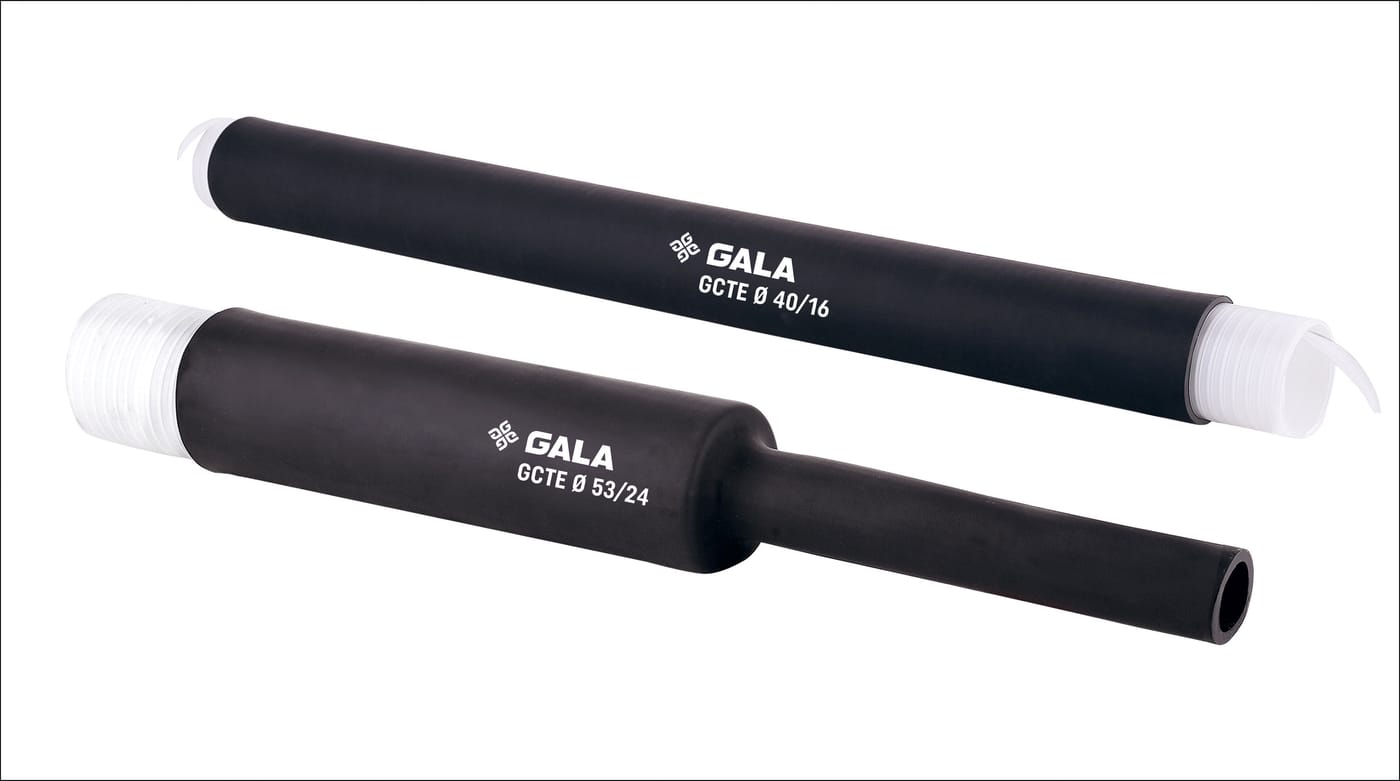
GCTE 40/16 on its core, GCTE 53/24 part recovered
Both sleeves are black, which is the colour row on the EPDM datasheet. The silicone sheet prints grey. The white spiral inside the upper sleeve is the core: pull it out and the tube recovers, with no heat and no recovery temperature to hit.
The code printed along the body is GCTE. Silicone in the identical seven sizes is coded GCTS on its own datasheet, which is the third disagreement below.
The three published materials, on the axes that decide
Values are the manufacturer's own, for GMW/GHW, GCTE and GCTS. Methods sit in the tables below.
| Decision | Crosslinked polyolefin | EPDM (GCTE) | Silicone (GCTS) |
|---|---|---|---|
| How it recovers | Applied heat, 125 °C shrink temperature on GMW/GHW | Pull the core out, no heat | Pull the core out, no heat |
| Continuous limit | -40 to +110 °C on GMW/GHW, -55 to +125 °C on GSC thin wall | -40 to 105 °C | -40 to 105 °C |
| Voltage it is written for | 3.3 kV on GMW, 36 kV on GHW, GDLT and GAT | 1.1 kV | 1.1 kV |
| Colour as published | Black on GMW/GHW, seven standard colours on GSC | Black | Grey |
| Chemistry declared on the sheet | Halogen free, carbon black for UV on GMW/GHW | Free of chloride and sulfur | Free of chloride and sulfur |
| What rules it out | A site that will not permit a flame or a hot-work permit | Anything above 1.1 kV or above 105 °C | Anything above 1.1 kV, and the lowest tensile of the three at 6.0 MPa |
Measured properties, as published
| Property | Crosslinked polyolefin (GMW/GHW) | EPDM (GCTE) | Silicone (GCTS) | Test method |
|---|---|---|---|---|
| Tensile strength | 12 N/mm² (min.) | 9.6 MPa ultimate | 6.0 MPa (min.) | ASTM D638; ASTM D-412 for the rubbers |
| Ultimate elongation | 350% (min.) | 750% | 400% (min.) | ASTM D638; ASTM D-412 for the rubbers |
| Hardness | 45 ± 10 Shore D | not on the sheet | 40 ± 10 Shore A | ASTM D2240 |
| Tear strength | not on the sheet | 26.3 kN/m, Die C | 25.0 kN/m (min.) | ASTM D-624C; ASTM D-624 |
| Density | 1.0 ± 0.2 gm/cm³ | not on the sheet | not on the sheet | ASTM D792 |
| Water or moisture absorption | 0.5% (max.) | 1.8% weight gain, 7 days at 90 °C | not on the sheet | ASTM D570; internal method for EPDM |
| Fungus resistance | not on the sheet | 28 days exposure, no growth | 28 days exposure, no growth | ASTM G-21 |
| Continuous temperature limit | -40 °C to +110 °C | -40 °C to 105 °C | -40 °C to 105 °C | IEC 216; no method printed on either rubber sheet |
| Shrink temperature | 125 °C | none, recovery is mechanical | none, recovery is mechanical | IEC 216 |
| Dielectric strength | 12 kV/mm (min.) at a 2 mm wall | 14.3 kV/mm | 18.0 kV/mm (min.) | ASTM D149 |
| Volume resistivity | 1 × 10¹² Ohm.cm (min.) | not on the sheet | 1 × 10¹² Ohm.cm (min.) | ASTM D257 |
| Water seal requirement | not on the sheet | meets ANSI C119.1 | meets ANSI C119.1 | ANSI C119.1 |
For GMW/GHW medium and heavy wall, GCTE cold shrink and GCTS cold shrink. "Not on the sheet" means that datasheet carries no such row; thin-wall polyolefin publishes different figures and sits in the temperature table further down.
Crosslinked polyolefin is a family name, not a specification
Three grades on this site declare the same polymer and hold the same 125 °C shrink temperature. Their electrical numbers are nowhere near each other.
GRT, the red build-up insulation, publishes 22 kV/mm against GMW/GHW's 12, and volume resistivity a hundred times higher. GAT, the non-tracking grade, sits between them on strength and gives up 10 °C of continuous limit to get a property none of the others has at all. A clause that names the polymer has specified almost nothing. Name the grade code.
One polymer name, three grades
| Property | GMW / GHW | GRT (INSULTUBE Red) | GAT anti-tracking | Test method |
|---|---|---|---|---|
| Dielectric strength | 12 kV/mm (min.) at a 2 mm wall | 22 kV/mm (min.) | 15 kV/mm (min.) | ASTM D149 |
| Volume resistivity | 1 × 10¹² Ohm.cm (min.) | 1 × 10¹⁴ Ohm.cm (min.) | 1 × 10¹⁴ Ohm.cm (min.) | ASTM D257 |
| Dielectric constant | 5 (max.) | 5 (max.) | 5 (max.) | ASTM D150 |
| Shrink temperature | 125 °C | 125 °C | 125 °C | IEC 216 |
| Continuous temperature limit | -40 °C to +110 °C | -40 °C to +110 °C | -40 °C to +100 °C | IEC 216; no method printed on the GRT row |
| Track, erosion or flame failure | not on the sheet | not on the sheet | none up to 3.25 kV for 20 min. | ASTM D2303 |
| Technical Qualification Report | QR 1013 | QR 1036 | QR 1021 | manufacturer's own reference |
GMW/GHW medium and heavy wall, GRT red build-up insulation, GAT anti-tracking. Every row is from the three datasheets.
Dielectric strength is not a ranking
Read that row and silicone looks like the strongest insulator here, 18.0 kV/mm against 12. The comparison is not worth making.
The figure is per millimetre and the walls are not the same. GMW/GHW's 12 is explicitly qualified at a 2 mm wall, GHW 40/12 recovers to 4.0 mm, and a cold-shrink sleeve recovers thin. What a finished wall withstands depends on the wall as much as on the figure, and the wall is usually what moved.
The method changes underneath the number too. GMW/GHW, GCTE and GCTS are all measured to ASTM D149. Thin-wall polyolefin quotes above 20 kV/mm to ASTM D2671 instead. GDLT quotes 20 kV/mm minimum on its insulating inner layer, while its semi-conductive outer layer carries no dielectric rating at all and 1 × 10³ Ohm.cm of volume resistivity. Figures from two methods do not belong in one league table.
Continuous temperature limit, series by series
| Series | Material as published | Continuous limit | Method |
|---|---|---|---|
| GSC and GSC/YG thin wall, flame retardant | crosslinked polyolefin | -55 °C to +125 °C | IEC 216 |
| GLC-SV vented thin wall | crosslinked polyolefin | -40 °C to +125 °C | IEC 216 |
| GDW dual wall and GDWH harness | polyolefin co-extruded over hot-melt adhesive | -55 °C to +125 °C, qualified as outer wall on GDW | IEC 216 |
| GMWR and GHWR co-extruded | polyolefin with a hot-melt adhesive lining | -55 °C to +125 °C, qualified as outer wall | IEC 216 |
| GMW and GHW medium and heavy wall | crosslinked polyolefin | -40 °C to +110 °C | IEC 216 |
| GRT red build-up insulation | crosslinked polyolefin | -40 °C to +110 °C | no method printed beside the row |
| GAT and GAT HW anti-tracking | non-tracking crosslinked polyolefin | -40 °C to +100 °C | IEC 216 |
| GDLT double layer | co-extruded crosslinked polyolefin | -40 °C to +100 °C | IEC 216 |
| GCTE cold shrink | EPDM | -40 °C to 105 °C | no method printed, feature list only |
| GCTS cold shrink | silicone | -40 °C to 105 °C | no method printed, feature list only |
Read this column first. Everything else on a datasheet is negotiable against wall and size; this is not.
Three places the manufacturer's own sources disagree
The GMW/GHW product page claims a dielectric strength of 15 kV/mm; both GMW/GHW datasheets, standard and flame retardant, print 12 kV/mm minimum at a 2 mm wall to ASTM D149. The GDW dual wall sheet gives -55 °C to +85 °C in its feature list and -55 °C to +125 °C in its own table on the same page, the second figure qualified as the outer wall only — design the assembly to the lower one until it is resolved. And the silicone product page reproduces GCTE part codes while the silicone datasheet codes the identical seven sizes GCTS. Order silicone by the GCTS code or risk being quoted EPDM.
The chemistry declarations, and what each is doing there
- Free of chloride and sulfur
- Printed on both cold-shrink sheets. The manufacturer publishes the absence, not the reason; where a specification insists on it, the requirement usually traces to chloride stress-corrosion cracking of austenitic stainless steel. It is what lets a rubber sleeve onto stainless pipework that would reject a chloride-bearing elastomer.
- Halogen free
- Declared on GLC and GLC-SV, GSC, GMW and GHW, GRT and GAT. It governs what the tube emits in a fire, not how well it insulates, so it never appears in the electrical block and is easy to miss. Specify it for enclosed and public spaces where smoke and acid gas are the hazard. GSC adds flame retardant and self-extinguishing with a UL 224 VW-1 pass.
- Carbon black
- The GMW/GHW sheets carry a weathering line stating the material contains carbon black to protect it from UV light. That is why medium and heavy wall is standard black. Custom colours are offered on request and the sheets do not say what carries the UV package in them, so ask before putting a coloured medium-wall tube outdoors.
- Water absorption
- 0.15% max on thin-wall polyolefin, 0.2% max on GRT, 0.5% max on GMW/GHW and GDLT, all to ASTM D570. For a buried or submerged joint this row outranks tensile strength: it is what the wall itself takes up, before any adhesive or seal is considered.
- Fungus resistance
- ASTM G-21, 28 days exposure with no growth, on both cold-shrink materials and on the GOBT oil barrier sleeve. Thin-wall polyolefin declares inert to MIL-I-7444 instead. Two tests, two reports, no conversion between them — which matters on tropical and coastal work, where these two lines at the foot of the sheet settle more than the electrical block above them.
- Copper corrosion
- Good, to ASTM D2671B, on the thin-wall grades and on the co-extruded GMWR/GHWR. It says the compound will not attack the conductor it is shrunk onto, which is why it appears on harness tubing sitting against bare tinned copper and not on the heavy-wall sheets.
Tracking and erosion, the mechanism no property row predicts
Everything tabulated above is a bulk property measured through the wall. Tracking is a surface process, and none of those numbers forecast it.
The manufacturer names the driver on the GVOT sheet: the tubing protects substrates from erosion caused by leakage current. On a contaminated outdoor surface that current runs across the wetted film and dries it unevenly into bands. Small arcs bridge the dry bands. Each arc pyrolyses a trace of polymer into carbon, carbon conducts, and every track shortens the path for the next arc. Erosion is the same energy removing material rather than carbonising it. Both finish in a flashover across a wall that still measures its full recovered thickness and still passes every figure above.
The answer is the GAT series, a non-tracking crosslinked polyolefin for medium-voltage joints and terminations to 36 kV. Unlike the rest of the tube range it carries a tracking row, and the method is ASTM D2303: no track, erosion or flame failure up to 3.25 kV for 20 minutes. The same line appears on the anti-tracking cable breakout, the rain sheds and the creepage extension skirt in the same compound. Quote it by name, because no other property on the sheet substitutes for it and neither does more wall. The part is on anti-tracking tube.
Which material each series actually is
| Series | Material as published | Covered on |
|---|---|---|
| GLC, GLC-SV, GSC, GSC/YG, GLC3 | crosslinked polyolefin | Thin wall tube |
| GMW, GHW | crosslinked polyolefin | Medium and heavy wall |
| GRT, GRT HW, GRT EHW | crosslinked polyolefin | Medium and heavy wall |
| GDW, GDWH | polyolefin co-extruded over hot-melt adhesive | Dual wall tube |
| GMWR, GHWR | polyolefin with a hot-melt adhesive lining | Pipe and joint sealing |
| GMW 5x | crosslinked polyolefin | 5:1 tube |
| GDLT | co-extruded crosslinked polyolefin, insulating inner and semi-conductive outer | Screening tube |
| GCT | thermally stabilised crosslinked semi-conductive polymer | Screening tube |
| GVOT | crosslinked polyolefin with an integrated varistor stress-control system | Screening tube |
| GAT, GAT HW | non-tracking crosslinked polyolefin | Anti-tracking tube |
| GSF | crosslinked polyolefin | Fibre and CATV tube |
| GCTE | EPDM | Cold shrink tubing |
| GCTS | silicone | Cold shrink tubing |
Where this goes next
- The standards on a shrink tube datasheetWhat ASTM D149, ASTM D2671, IEC 216 and UL 224 VW-1 each test
- Heat shrink or cold shrinkTwo recovery mechanisms, and the 1.1 kV ceiling on one of them
- Shrink ratio explainedWhat 2:1, 3:1, 4:1 and 5:1 buy once the material is settled
- Why a recovered tube failsFive faults, and which of them a change of material actually fixes
- Heat shrink size chartSupplied ID, recovered ID and recovered wall for every series listed here
- Tube or moulded shapeWhere an extruded tube stops working whatever it is made of
Send the temperature and the substrate
A material question closes in one email when it carries four things: continuous service temperature, what the tube sits against, voltage class, and whether the site permits a naked flame.