Heat shrink · cold shrink · recovered walls 0.28 to 7.5 mm
Pick the tube by its recovered diameter, not by its name
A 34 mm lug on 18 mm cable needs a tube that clears 34 mm and still closes past 18 mm. No published 2:1 size does both. GMW 40/12, at 3:1, does.
- Thirteen series indexed here, GSC 1.0/0.5 through GHW 425/120, plus GCTE 104/42 in cold shrink.
- Every figure comes off the manufacturer's own selection charts: supplied ID, recovered ID, recovered wall, test method.
- Recovered ID is published by Gala Thermo Shrink Pvt. Ltd., which extrudes the tube at Palghar, Maharashtra. It is a reference, not a shop — no price, lead time or stock appears on it.
Three numbers, taken in this order
Work it on one job: a 34 mm crimp lug on 18 mm cable, to be insulated and sealed. The obstruction is 34 mm, the substrate is 18 mm, and one part has to straddle both.
1 · Measure the largest obstruction
Not the cable — the widest thing the tube travels over on its way down, which here is the 34 mm lug. Supplied ID has to exceed that with room to slide on. GMW 40/12 gives 40 mm supplied against a 34 mm lug.
2 · Divide by the ratio
2:1 halves the bore, 3:1 takes it to a third, GMW 5x to a fifth. The smallest 2:1 size that clears 34 mm recovers to 20 mm — GLC and GSC both step 30.0/15.0 straight to 40.0/20.0 — and 20 mm will never close on 18 mm cable. 3:1 is the entry point.
3 · Check what wall is left
GMW 40/12 lists 2.7 mm ±10%, and reaches it only by recovering all the way to 12 mm. Held open at 18 mm by the cable, it lands thinner than the chart says. Size the insulation against the wall you will actually get.
Every series on this site, by supplied and recovered ID
| Series | Supplied ID (mm) | Recovered ID (mm) | Recovered wall (mm) | Ratio |
|---|---|---|---|---|
| GSC | 1.0 – 100.0 | 0.5 – 50.0 | 0.28 – 1.17 | 2:1 |
| GLC | 6.0 – 100.0 | 3.0 – 50.0 | 0.56 – 1.27 | 2:1 |
| GLC3 | 1.5 – 39.0 | 0.5 – 13.0 | 0.45 – 1.15 | 3:1 |
| GLC-SV | 20.0 – 70.0 | 10.0 – 35.0 | 0.78 – 1.10 | 2:1 |
| GDW | 3.0 – 50.0 | 1.0 – 17.0 | 0.9 – 2.4 | 3:1 and 4:1 |
| GDWH | 5.75 – 18.30 | 1.25 – 7.40 | 0.60 – 0.90 | 4:1 |
| GMW | 10 – 425 | 3 – 120 | 1.5 – 3.5 | 3:1 |
| GHW | 12 – 425 | 3 – 120 | 2.4 – 4.5 | 3:1 |
| GMWR | 12 – 130 | 3 – 36 | 1.5 – 3.0 | not stated |
| GHWR | 12 – 140 | 3 – 42 | 2.2 – 4.2 | not stated |
| GMW 5x | 30 – 160 | 6 – 32 | 4.3 – 5.0 | up to 5:1 |
| GDLT | 30 – 120 | 11 – 45 | 5.0 – 7.5 | not stated |
| GCTE | 20 – 104 | 7 – 42 | not published | cold shrink |
Each range is the two ends of a published selection chart, not one part. Row by row: the heat shrink chart and the cold shrink chart. GDWH publishes two recovered-diameter columns, d (AL) 1.25 – 4.35 mm and d (J) 2.65 – 7.40 mm; the sheet's 4:1 ratio holds only against d (AL). Ratio reads "not stated" where the datasheet claims a high ratio and prints no figure.
Heat shrink and cold shrink are not two routes to one job
The recovery mechanism differs, so the install differs and the ceiling differs. The choice is argued out at heat shrink or cold shrink.
| Heat shrink | Cold shrink | |
|---|---|---|
| Recovery mechanism | Crosslinking locks in a shape memory; heat returns the tube to its moulded profile | Factory-expanded rubber on a removable core; pulling the core lets it contract |
| Base polymer | Cross-linked polyolefin | EPDM or silicone, both free of chloride and sulfur |
| Shrink temperature, IEC 216 | 125°C on GMW and GHW, 135°C on GDLT | None — it goes on at ambient, with no torch and no tools |
| Continuous limit, IEC 216 | −40°C to +110°C on GMW and GHW | −40°C to 105°C on GCTE |
| Dielectric strength, ASTM D149 | 12 kV/mm minimum on a 2 mm wall, GMW and GHW | 14.3 kV/mm on EPDM, 18.0 kV/mm minimum on silicone |
| Published voltage | 3.3 kV on GMW, 36 kV on GHW and GDLT | 1.1 kV, on conductor to 1000 sq mm |
| Sized on | Supplied ID over the obstruction, recovered ID under the substrate | An application range in millimetres — 8 to 94 across seven GCTE sizes |
| Standard on the sheet | IEC 60684-3-247 | ANSI C119.1 water-seal requirement |
What is not on this site
This index stops at extruded tube. Anything moulded to a shape is out — breakout boots, right-angle and straight boots, busbar shrouds, cable end caps, rain sheds — and so are complete joint and termination kits, which are counted packing lists rather than a length of tube. Tube or moulded shape draws that line part by part and names the reference site carrying each one, all published by the same manufacturer as this one. Busbar sleeving is the clearest case: its chart is read on rectangular bar width plus breadth, or on round bar diameter, never on a single bore. That is a different axis, and it sits at busbarsleeves.com.
Two absences are deliberate. Nothing in the cold-shrink range is rated above 1.1 kV, so an 11 kV cold-shrink joint is a request this reference cannot answer, and it says so rather than steering you at a heat-shrink part you did not ask for. And no price, lead time or stock position appears anywhere; those are the manufacturer's to give. The contact page lists what to put in a first message so the reply comes back with a size in it.
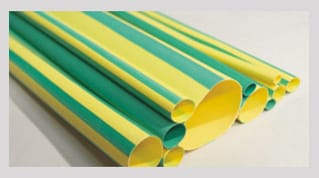
Two numbers decide almost everything and the product name decides very little. GSC and GLC quote an identical recovered wall at every size their two charts share — 0.56 mm at 8.0/4.0, 0.78 mm at 20.0/10.0, 0.97 mm at 40.0/20.0 — so diameter cannot separate them. Flammability and colour can: the GSC sheet records a UL 224 VW-1 pass and eight standard colours including the yellow/green earth stripe, while the GLC sheet prints no flammability row and one colour, black. The two also disagree on voltage. GLC's datasheet says 3.3 kV, GSC's datasheet says 600 V, and the manufacturer's web page for GSC says 3.3 kV. Differences of that kind are what this reference exists to surface, grade by grade.
Where the numbers actually live
Two charts and four arguments. Everything else on the site hangs off these.
- Heat shrink size chartGSC, GLC, GLC3, GLC-SV, GDW, GMW, GHW, GMWR, GHWR and GMW 5x, row by row
- Cold shrink size chartGCTE read on application range rather than on a nominal size
- Shrink ratio explainedWhy 2:1 lost the 34 mm lug and 3:1 took it
- Polyolefin, PVC, EPDM, siliconeChosen on operating temperature and on what the tube has to sit in
- The standards on the sheetWhat ASTM D149, IEC 60684-3-247, UL 224 VW-1 and ANSI C119.1 each test
- Why a recovered tube failsFive faults, read backwards off the part that failed
Send the diameter, not the part number
Give the obstruction, the substrate diameter, the voltage class and the site conditions in the first message, and the manufacturer can come back with a size instead of a question.