Application
Pipe supports and pipe joints: shrink tube against contact corrosion
GHWR 140/42 comes down to 42 mm behind a 4.2 mm wall; GLC-SV 70/35 pulls onto a bend at 1.10 mm with nothing smeared under it.
Specify on recovered ID, not on pipe size
Two numbers close this out: recovered ID and recovered wall. Nominal pipe size will not. The tube has to clear the fitting at supplied ID, then close on the metal at recovered ID, and the wall you are left with is what the recovery leaves behind.
At a clamp or a bend, take a thin hard coat that will follow a curve: GLC-SV, 0.78 to 1.10 mm recovered wall, 2:1. At a joint, take wall with adhesive under it: co-extruded GHWR, 2.2 to 4.2 mm. These are two failures, not one, and they do not share a part.
The one at the support starts in the contact patch, where moisture sits under an uncoated clamp. The manufacturer's U-bolt coating sheet names support-point corrosion the leading cause of process pipe failure, and pinhole leaks are how it finishes. Pipes in refineries, chemical plants and offshore platforms rest on or are secured to structural beam supports, so the patch is wherever the steel touches.
The vented grade: a groove instead of a lubricant
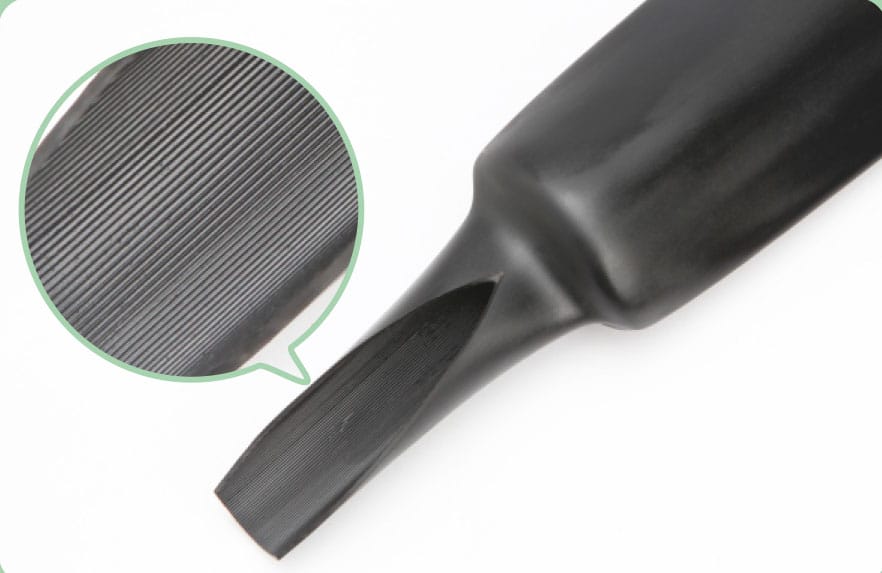
Recover a plain 2:1 tube over a bend and it wrinkles, because the air underneath has nowhere to go. GLC-SV moulds an air-vent groove into the inner wall, shown in the inset above, and the trapped air walks out along it as the wall comes down. The datasheet states the benefit as a negative: a wrinkle-free finish on bend areas without grease or any other lubricant.
Eight sizes, 20/10 to 70/35, recovered wall 0.78 to 1.10 mm. Read that as a coat, not as armour. Black is the standard colour, UV stabilised, halogen free, RoHS compliant.
The sheet aims the grade at wind power anchor bolts, automotive parts and threaded fasteners. On a pipe run that is the curved shank of the clamp, the one surface a plain tube cannot follow. The bolt case on its own is indexed at the same manufacturer's U-bolt support reference on heatshrink-sleeve.com.
GLC-SV vented thin wall, selection chart
| Part number / size | Supplied ID (mm) | Recovered ID (mm) | Recovered wall (mm) | Spool (m) | Cut lengths per box, 1.2 m |
|---|---|---|---|---|---|
| GLC-SV 20/10 | 20.0 | 10 | 0.78 | 100 | 65 |
| GLC-SV 25/12.5 | 25.0 | 12.5 | 0.78 | 50 | 40 |
| GLC-SV 30/15 | 30.0 | 15.0 | 0.87 | 50 | 30 |
| GLC-SV 40/20 | 40.0 | 20.0 | 0.97 | 50 | 20 |
| GLC-SV 45/25 | 45.0 | 25.0 | 0.97 | 50 | 20 |
| GLC-SV 50/25 | 50.0 | 25.0 | 0.97 | 25 | 15 |
| GLC-SV 60/30 | 60.0 | 30.0 | 0.96 | 25 | 10 |
| GLC-SV 70/35 | 70.0 | 35.0 | 1.10 | 25 | 10 |
Reproduced from the manufacturer's [vented thin wall tube datasheet](https://www.galathermo.com/pdf/Heat Shrinkable Vented Thin Wall Tube.pdf). Two rows do not follow the series: the 70/35 recovers to a 1.10 mm wall against the 0.97 mm the other large sizes carry, and the 45/25 recovers 1.8:1 where the series is stated at 2:1. Every recovered diameter on this site sits on one axis at the heat shrink size chart.
GLC-SV thermal limits
| Property | Value | Standard |
|---|---|---|
| Operating temperature | -40 to +125 °C | IEC 216 |
| Low temperature flexibility, -55 °C for 4 hrs | No cracking | ASTM D2671 |
| Heat shock, 250 °C for 4 hrs | No dripping, cracking or flowing | None printed on the sheet |
GLC-SV water and chemical resistance
| Property | Value | Standard |
|---|---|---|
| Water absorption | 0.15 % (max.) | ASTM D570 |
| Chemical resistance | Good | ASTM D2671 |
| Copper corrosion | Good | ASTM D2671B |
Water absorption is the row to read before a trench or a splash zone closes over the tube.
The joint: co-extruded, adhesive on the inside face
GMWR and GHWR are the co-extruded grades, medium wall and heavy wall, hot-melt adhesive on the inside face. The sheet lists three jobs for them on pipe: corrosion protection, environmental sealing, and mechanical protection of pipe connections. Technical Qualification Report QR 1014.
The adhesive is an ordering decision, not an assumption, and the part number carries it. GMWR 12/3 A 1000 reads code, then size, then A for adhesive, then length in millimetres. Drop the A and the same size arrives as mechanical cover with nothing sealing behind it.
Watch which series an IP figure came off. IP 68 is printed against the optional hot-melt adhesive on the plain GMW and GHW series, not on the co-extruded sheet, which claims waterproofing and environmental sealing without naming a class. Both sheets state conformity to IEC 60684-3-247, and what that standard actually tests is set out on the standards page.
GMWR medium wall, co-extruded, selection chart
| Code | Supplied ID, D min (mm) | Recovered ID, d max (mm) | Wall T ±10 % (mm) |
|---|---|---|---|
| GMWR 12/3 | 12 | 3 | 1.5 |
| GMWR 22/6 | 22 | 6 | 2.0 |
| GMWR 27/8 | 27 | 8 | 2.5 |
| GMWR 33/10 | 33 | 10 | 2.5 |
| GMWR 40/12 | 40 | 12 | 2.5 |
| GMWR 50/16 | 50 | 16 | 2.5 |
| GMWR 63/19 | 63 | 19 | 2.5 |
| GMWR 72/22 | 72 | 22 | 2.5 |
| GMWR 92/27 | 92 | 27 | 3.0 |
| GMWR 130/36 | 130 | 36 | 3.0 |
From the manufacturer's [co-extruded tubing datasheet](https://www.galathermo.com/pdf/Heat Shrink Co-Extruded Tubing Premium Quality.pdf), Issue 2, February 2024. D is supplied internal diameter, d is recovered internal diameter, T is recovered wall. Every charted row clears 3:1 on D min over d max, and the 12/3 reaches 4:1.
GHWR heavy wall, co-extruded, selection chart
| Code | Supplied ID, D min (mm) | Recovered ID, d max (mm) | Wall T ±10 % (mm) |
|---|---|---|---|
| GHWR 12/3 | 12 | 3 | 2.2 |
| GHWR 22/6 | 22 | 6 | 2.5 |
| GHWR 30/8 | 30 | 8 | 3.0 |
| GHWR 43/12 | 43 | 12 | 4.0 |
| GHWR 51/16 | 51 | 16 | 4.0 |
| GHWR 72/22 | 72 | 22 | 4.0 |
| GHWR 85/25 | 85 | 25 | 4.0 |
| GHWR 105/30 | 105 | 30 | 4.0 |
| GHWR 120/36 | 120 | 36 | 4.0 |
| GHWR 140/42 | 140 | 42 | 4.2 |
Same sheet. One row to settle before you order: the code column prints the 51 mm entry as GHWR 651/16 while its own dimension column reads 51, so treat it as 51/16 and confirm the code in writing. The co-extruded sheet states only a high shrink ratio; the manufacturer's U-bolt coating sheet, QR 1025, prints 3:1 against the same GMWR and GHWR codes.
Three GMWR charts, three different 12 mm tubes
The GMWR/GHWR chart appears on at least three of the manufacturer's own sheets and they do not agree. The co-extruded sheet charted above, Issue 2 dated February 2024, gives GMWR 12/3 a 1.5 mm wall. An undated GMWR/GHWR sheet gives GMWR 12/5 1.8 mm and carries the series out to 200/64. The U-bolt coating sheet, QR 1025, gives GMWR 12/4 1.65 mm and starts two sizes lower, at 9/3. Continuous temperature splits the same way: -55 to +125 °C on the manufacturer's co-extruded web page against -40 to +110 °C on both the undated sheet and QR 1025. Quote the sheet revision beside the part number, or you can be shipped a different wall from the one you sized.
How the site moves the choice
Same two parts; four reasons the specification tightens.
Refinery and chemical plant supports
Heat, ultra-violet, vibration and sandblasting are the four insults the coating grade is stated to be unaffected by. The subtler gain is paint: the polyolefin is hard enough to shield the paint film as the clamp is torqued down, and it sets up no capillary crevice round the pipe for water to sit in.
Offshore, marine and oil and gas
Jacket tear resistance and elastomeric behaviour earn the tube its place here: it has to follow an irregular contour without splitting at the shoulder. Medium and heavy wall material carries carbon black against UV and black is the standard colour, so a colour request is a weathering decision before it is a cosmetic one.
Buried and immersed plant
Below ground the adhesive is the product and the tube is its carrier. Order the A suffix, and prove the bead on a sample joint before the trench closes. The mode where the adhesive never reached flow temperature is at why a recovered tube fails.
Bends, anchor bolts and clamps
Curved work is where the vented grade pays for itself, and it is 2:1 only. Supplied ID has to clear the widest part of the fastener before the tube will recover onto the shank, which is tighter than it looks. Check it against shrink ratio before you order a size down.
Casing seals, line coating and pressure: not this part
A casing end seal is a different part. Sealing the casing end of a pre-insulated pipe at the weld joint is the manufacturer's GPPC pre-insulated pipe sealing cap, a moulded heat-shrink cap with hot-melt adhesive, on its own datasheet with its own chart. Nothing on this page is that part, and no tube substitutes for it.
Coating a whole buried line, field joints included, is a wraparound sleeve job and again a different part. A recovered tube carries no internal pressure and restores no lost wall, so it does not repair a pipe that is already leaking; it protects sound metal from what is about to attack it.
No potable-water or food-contact approval is printed on any of the three datasheets behind this page. Read a plumbing enquiry as external protection of the fitting, not as anything in contact with the water.
Next, by the number you already have
- Medium and heavy wall, GMW and GHWThe unlined series, and where the 1200 mm maximum cut length bites
- Dual wall adhesive-lined tubingSmaller diameters, where the adhesive bead is the whole product
- Thin wall tube, GLC seriesThe unvented sizes, for a straight surface with no bend in it
- Heat shrink size chartEvery supplied and recovered diameter on the site, one axis
- Polyolefin, PVC, EPDM and siliconeSettle temperature and chemistry before you settle a wall
- Installing heat shrink tubeGun distance and stroke order, including the vented exception
Send the diameter and the substrate
Four lines make an enquiry quotable: fitting or fastener outside diameter, recovered wall wanted, adhesive or none, and the site temperature range.